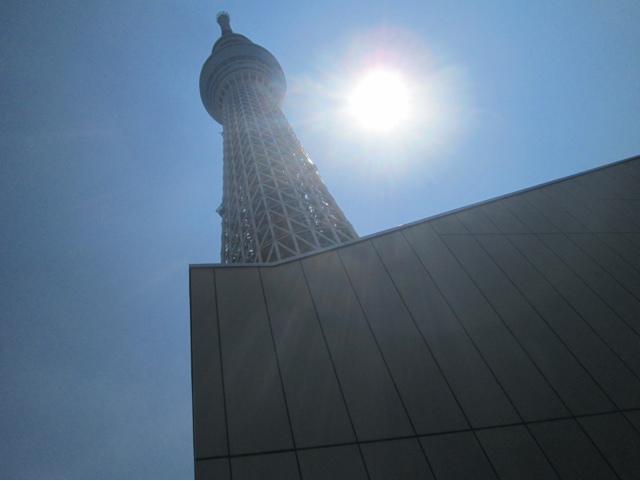
Our final full day in Tokyo led us to the top of the Sky Tre, the world's tallest tower (not BUILDING, mind you, but TOWER), where two hours of waiting in line and $30 of enterance feeds a pop did indeed pay off with some nose-bleedingly awesome views of the city. What impressed us the most was how the elevator covered the equivalent of the height of the Empire State Building's height in a smooth, 45 second shoot. Then you took ANOTHER eleveator that brought you even higher. One level had a glass floor you could walk on and see the city beneath you - I wish the photos had #1 come out better, and #2 captured the screams of the patrons.
Thursday, August 8, 2013
The Ghastly Ordeal of the Capsule Hotel
Back to Planet Tokyo, we had, by design, booked a night in a Japanese "capsule hotel," just because we had heard of them and were insanely curious about the experience. What we experienced in the end most certainly satisfied our curiosity for insanity.
First of all, FINDING the damned place was a pain and a half. We engaged in an epic quest comparable to the one for the Indian restaurant, only compounded by the fact that it was Tokyo, at the tail end of rush hour, and we were carrying awkward travel bags. After a merry chase across several subway lines we plumbed the heart of Tokyo's red-light district, where hawkers stood outside "massage palors" offering a good time with their girls to everyone BUT the two bedraggled, pushing-middle-age-tourist Gaijin in sweat-soaked clothing. Us, we were invisible...not the target clientiele, perhaps.


Yet another one for the "WTF, Japan" file?
After asking all manner of folk directions and wandering well into the wee hours of the night, we did eventually find the capsule hotel.
To cut ourselves some slack, a few factors HAD stacked the odds against us:
1. Despite the name, there is no actual GREEN signage anywhere on the Green Plaza building. The giant, building-high sign is blue.
2. The sign is entirely in Japanese.
3. There IS a very tiny, lunchbox-sized green sign with English on it It's blocked entirely by a potted plant next to the door.
Going inside we found a dark, empty lobby, where tucked away by an elevator in back was another sign, also bearing English, for the hotel, right above a sign for "Korean Pinko Pickpocket 24 hours!" Now, normally, raging bull elephants could not keep me from investigating something like that, but we were bone-weary from our day (remember, this is the SAME DAY we had been at the Hiroshima Peace Day ceremonies AND Miyajima!), so all we wanted was just to find our damned capsules and pass out in them.
When the elevator doors opened on the fourth floor, they revealed a dimly lit locker room and check-in desk where a small collection of drunk and tired looking middle aged Japanese businessmen all turned their eyes on us. Through a hilarious serious of translation mishaps (owing to both fatigue and the fact that, as mentioned, I had lost my freaking dictionary), we managed to get the "rules" of the place explained to us.

We were to turn over everything we had, INCLUDING OUR CLOTHES, to the reception staff, who gave us beate-up burlap yukatas (bathrobes) to wear instead. We were fordibben from leaving the hotel unless we filled out all manner of forms with the desk. But as long as we were there, we had full run of the many floors, which included an onsen, several smoking lounges, a restaurant, and many, many massage parlors, each advertising its own panoply of lovely ladies in Chinese dresses (oddly enough, the actual women wandering about these places looked much older, and less comely, than those in the photos). We were issued a wristband with a bar code, and anything we ordered to eat (and presumably, anyONE we ordered, should we have partaken in the messages, which we didn't, incidentally) got charged to our account.

In short, the whole enterprise seemed designed to keep drunk, exhausted Japanese businessmen off the streets, by institutional compulsion, and occupy them with various amenities until such time as they sobered up and were ready to go home or start the next day of work. Women were not allowed to stay here, although plenty of women staffers (tired, hard and bitter looking) were about, even in the (many) areas where the businessmen wandered around half or even fully naked, and everyone seemed to ignore everyone else. Even when not sleeping in the physical capsules, everyone was in his or her own "capsule" of the mind...other than the sound of spitting and late-night television, the place was almost entirely silent.
Josh referred to it as "a one-star version of club med," while I preferred to think of it as the instition from One Flew over the Cuckoo's Nest meets Lost in Translation...Japanese purgatory, where lost souls in kimono wandered the halls, smoking and spitting (oh lord, the amount of loud, noisy expectoration, 24-7, from all quarters), getting food and getting massaged while they ate, all looking dead-eyed and listless and of course, unable to leave. "Welcome to the Hotel California, indeed.
(for those who read Cloud Atlas, the references we kept making to the "Ghastly Ordeal of Thomas Cavendish" never stopped)
The capsules themselves went on in stacked rows forever, down dark empty corridors monitored by videocameras. It was like a topiary maze of 1970s brown pastel plastic, or a First Person Shooter game where you wander empty halls until you happen upon a shambling Japanese businessman, whereupon you unload with your BFG. It's silent as the grave down there except for an electronic hum, because who knows if someone's sleeping, so you have to be courteous. Each capsule was just larg enough to accomodate just one body-length, on a cushion, and you can look up and watch a small black and white pay per view TV whose channel selection is pretty much limited to NHK State News and porn. There is a light in your capsule should you wish to read, and a battered puke-brown windowshade you can pull if you do not wish to see even the eternal artificial twilight of the corridor.
We slept surprisingly well.


Despite our fears, we were indeed allowed to leave with our clothes the next day. We had sampled the restaurant (fair to middling), the onsen (might have been nice without all the loogie spitting old Japanese dudes), but not the massages...somehow that seemed like "eating the food in the town of ghosts" that henceforth would have bound us to that strange demon realm forever.
I accidentally stole their pen, though, so I may well have to come back some day.
At that very moment, the 80s band Foreigner walked by and said, "Hey, I guess we're still big in Jpan, guys!" They then proceeded to launch into "I want to know what love is" until hauled off by the Yakuza.
Us on Japanese TV
Not my most flattering angle...probably fulfilling all Japanese stereotypes of crazy Gaijin, but oh well... :)
- D
Miyajima, you Jane
We had planned for a post-Hiroshima de-stress on the nearby island of Miyajima, famed for its floating tori gates and its ancient history of peace and holiness, not to mention creepy eugenics - no sick or disabled people were allowed to be on the island, and you had to get kicked off if you became either...oh, and women couldn't set foot on the land, either.
Nowadays, its a big tourist site, mostly for the Japanese...the train and ferry ride out there is a little cumbersome to deal with, but not for us holders of the JR pass!


Actually, the tourism bureau is well aware of JR pass holders, especially as regards to the island's native deer population's predilection for eating them. A warning sign *specifically* cautioned you to not let the deer eat your JR pass. We wanted to test this odd- sounding warning first hand, Mythbusters-style, so the moment we arrived I asked the lady at the ferry terminal where we could find the deer.
Now, I had forgotten the word for "deer" in Japanese, and, as mentioned last post, we had lost my dictionary somewhere in the peace park, so I went with "shishi-gami," which is the name of the Deer God from the anime "Princess Mononoke." What I asked was probably something to the effect of, "Excuse me, but where might I find the divine deer spirits?"
The woman blinked, sighed, and said with the closest thing to an eye roll I've seen in Japan, "everywhere."
Indeed, the deer were quite ubiquitous, wandering here and there but mostly just finding shady spots to veg out in. They tended to congregate most often around the most photogenic landmarks, probably having long ago learned that that was where humans tended to visit, and where there were humans, there would be food.
Approaching one of the deer, Josh took out his JR pass and waved it about...and sure enough, the deer made a lunge for it. The contest of reflexes was actually much closer than we had expected.
Still, no deer related mishaps occured (although one did sneak-attack me for my bag later down the line), and we explored 1500 year old temples in what felt like 1500 degree heat.

Bad horse's Japanese counterpart! Josh even composed a theme song for him:
"Bad-u horse, bad-u horse, he rides across the nation, like the East wind, disrespecting your ancestors...please understand, we are not implying that the wind would disrespect your ancestors, many apologies...bad-u horse!"
Only when we perused our photos later did we realized how sweat-soaked and delerious we looked in all of them, likely fulfilling everyone's nightmare image of two giant, sweaty Gaijin gorillas thundering about precious historical sites, teasing the divine deer spirits.
Tuesday, August 6, 2013
Hiroshima
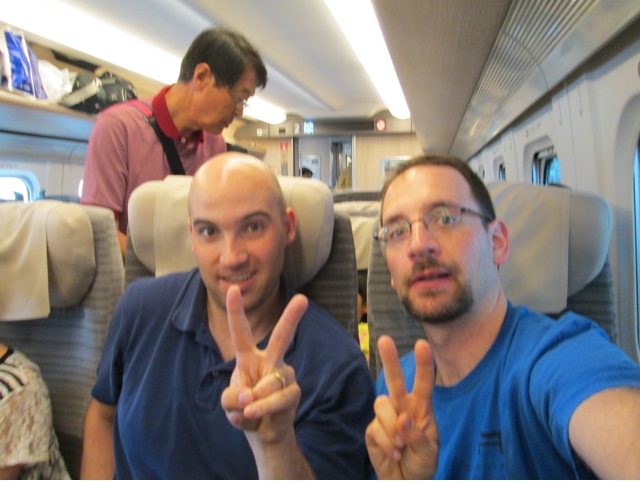
Shinkansen bullet train - 180 mph, smooth ride - amazing what a country that cares enough to invest in its transportation infrastructure can do, eh?
Whee!

Osaka - in a nutshell:

Ok, so I suppose this is where the "Hiroshima Entry" really begins.
So this is the entry about Hiroshima.
I've had great difficulty trying to frame this entry, because it is so easy to get wrapped up in discussing/analyzing/ranting about history, responsibiity, atrocity, etc...and for sure, if anyone *wants* to hear my take on Hiroshima, the firebombings, the Pacific War in general, I'm happy to respond "off the air," as it were.
The challenge, of course, is that I don't think those issues can be divorced from any meaningful reflection on visiting the city, especially this day. What struck me a great deal about the Peace Day ceremonies this morning was the intense effort to make it "apolitical" (e.g., no flags, from any country, were allowed on the grounds of the Peace Park), but such omissions also make a variety of political and historical statements in and of itself.
So for the moment, I'll just say, there are Japanese narratives of history that paint a very different picture of the events leading up to, taking place during, and that ended, the Pacific War. I was aware of these narratives long before I came to Hiroshima - they aren't even explicitly mentioned here in the city, although you can perceive their echoes if you know where to look. I will say that at least some aspects of these narratives are persuasive to me, and worth at least knowing about. You can ask me if you're curious, and if you wish, and you can make your own decisions about the info.
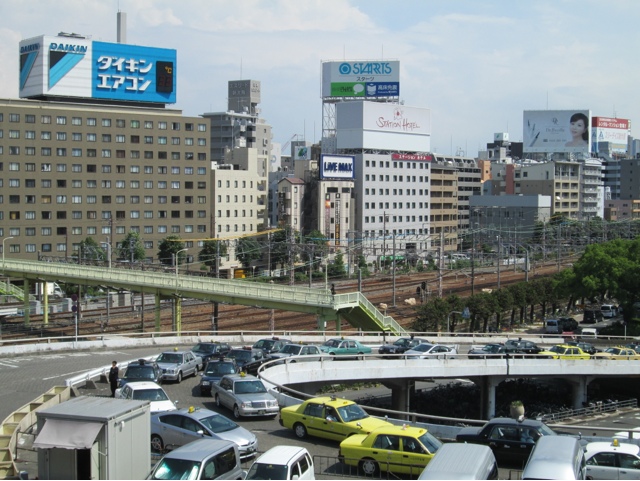
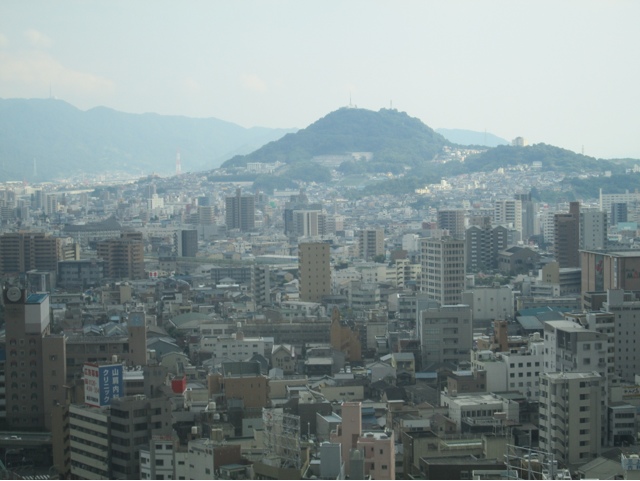
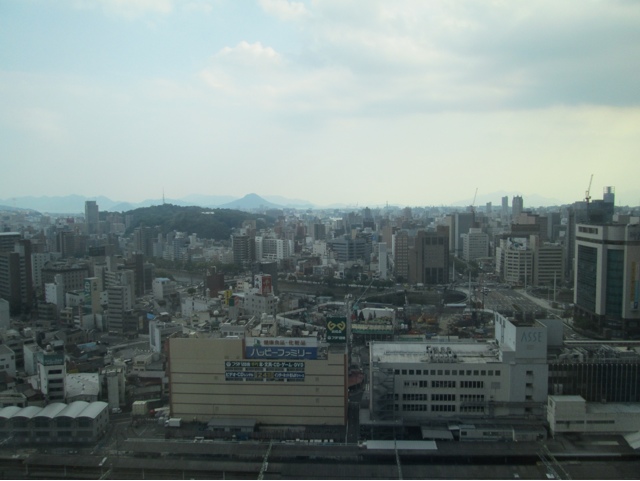
As a city, with which I have now only made the most passing acquaintance, Hiroshima seems oddly schizophrenic. On the one hand, it is a large city like any other large city in Japan, or in the developed world in general: if you were to be dropped into it tomorrow and not told its name, you would have absolutely no idea it was one of only two cities on the planet to have suffered nuclear attack. Skyscrapers, parks, stores, trams, factories, hotels, houses, traffic jams both automotive and pedestrian. Other than their slightly tough-for-me-to-understand regional accent, the people here don't look or act any different from anyone else I've met in Japan. There isn't rubble or ruins anywhere, and the memorials that do exist are in very specific places and hardly scream out at you. Life proceeds as it would in any other first world metropolis.
On the other hand, there are things you notice. When you do interact with the touristy parts of the city, you can see immediately how it has "branded" itself. Every map highlights the a-bomb site, the peace park. There are streets called "Hewia Dori" ("Peace Boulevard") and temples devoted to peace. Touristy stores offer "peace sholes" and other such trading-on-the-antiwar-brand stuff. It would be as if, post-9/11, New York reorganized its entire foreign tourism pull around Ground Zero...no, even more than that...think Gettysburg. For the people who live there, eh, whatever, it's your home city, in much the same way I really seldom if ever think about Boston's colonial history. But who the hell comes to Gettysburg s a tourist except to visit the infamous battle site? Who would ever have KNOWN about Gettsyburg otherwise?
And that leads to another strangeness: An awful lot of people in Hiroshima have a basic command of English, people you wouldn't expect to (i.e., not just in the tourism/hospitality field). This is a city used to Westerners coming, beckoning to them in a way that Japan's other major cities don't seem to feel the need to do. And of course, Peace Day is the day it kicks this process into highest gear: this is the cash cow, this is what fills the hotels and books all the taxis. The hotel in which we stayed was hosting an "American culture fest," showcasing everything from hot dogs in their restaurant to pictures of Dobie Gillis and Homer Simpson. "Come on in," everyone and everything seems to say. "We don't hate you. We're friendly."
The strategy struck me to be at the same time humiliating and extremely canny/mercenary. I found it fascinating.
While I came on August 5th prepared to face an aura of solemnity, the city, while clearly gearing up for a big event, seemed utterly (and therefore, to me, somewhat unsettlingly) normal. We had our predictable saga of getting lost in the Hiroshima JR station (which has, hands down, the most maddeningly useless and confusing directional signage of any building I've ever been in...I can't tell you how many times we walked around in circles, desperately trying to find the "North Exit," which is only labled "Shinkansen (high speed train) exit," even though all the other exits are labeled directionally, and even the Shinkansen exit isn't actually an exit....blaaah!). We got caught in a massive rainstorm. We ate at a restuarant simply because we were intrigued by the English sign, "We have a genuine British waiter," and true enough, they did).
The challenge, of course, is that I don't think those issues can be divorced from any meaningful reflection on visiting the city, especially this day. What struck me a great deal about the Peace Day ceremonies this morning was the intense effort to make it "apolitical" (e.g., no flags, from any country, were allowed on the grounds of the Peace Park), but such omissions also make a variety of political and historical statements in and of itself.
So for the moment, I'll just say, there are Japanese narratives of history that paint a very different picture of the events leading up to, taking place during, and that ended, the Pacific War. I was aware of these narratives long before I came to Hiroshima - they aren't even explicitly mentioned here in the city, although you can perceive their echoes if you know where to look. I will say that at least some aspects of these narratives are persuasive to me, and worth at least knowing about. You can ask me if you're curious, and if you wish, and you can make your own decisions about the info.
As a city, with which I have now only made the most passing acquaintance, Hiroshima seems oddly schizophrenic. On the one hand, it is a large city like any other large city in Japan, or in the developed world in general: if you were to be dropped into it tomorrow and not told its name, you would have absolutely no idea it was one of only two cities on the planet to have suffered nuclear attack. Skyscrapers, parks, stores, trams, factories, hotels, houses, traffic jams both automotive and pedestrian. Other than their slightly tough-for-me-to-understand regional accent, the people here don't look or act any different from anyone else I've met in Japan. There isn't rubble or ruins anywhere, and the memorials that do exist are in very specific places and hardly scream out at you. Life proceeds as it would in any other first world metropolis.
On the other hand, there are things you notice. When you do interact with the touristy parts of the city, you can see immediately how it has "branded" itself. Every map highlights the a-bomb site, the peace park. There are streets called "Hewia Dori" ("Peace Boulevard") and temples devoted to peace. Touristy stores offer "peace sholes" and other such trading-on-the-antiwar-brand stuff. It would be as if, post-9/11, New York reorganized its entire foreign tourism pull around Ground Zero...no, even more than that...think Gettysburg. For the people who live there, eh, whatever, it's your home city, in much the same way I really seldom if ever think about Boston's colonial history. But who the hell comes to Gettysburg s a tourist except to visit the infamous battle site? Who would ever have KNOWN about Gettsyburg otherwise?
And that leads to another strangeness: An awful lot of people in Hiroshima have a basic command of English, people you wouldn't expect to (i.e., not just in the tourism/hospitality field). This is a city used to Westerners coming, beckoning to them in a way that Japan's other major cities don't seem to feel the need to do. And of course, Peace Day is the day it kicks this process into highest gear: this is the cash cow, this is what fills the hotels and books all the taxis. The hotel in which we stayed was hosting an "American culture fest," showcasing everything from hot dogs in their restaurant to pictures of Dobie Gillis and Homer Simpson. "Come on in," everyone and everything seems to say. "We don't hate you. We're friendly."
The strategy struck me to be at the same time humiliating and extremely canny/mercenary. I found it fascinating.
While I came on August 5th prepared to face an aura of solemnity, the city, while clearly gearing up for a big event, seemed utterly (and therefore, to me, somewhat unsettlingly) normal. We had our predictable saga of getting lost in the Hiroshima JR station (which has, hands down, the most maddeningly useless and confusing directional signage of any building I've ever been in...I can't tell you how many times we walked around in circles, desperately trying to find the "North Exit," which is only labled "Shinkansen (high speed train) exit," even though all the other exits are labeled directionally, and even the Shinkansen exit isn't actually an exit....blaaah!). We got caught in a massive rainstorm. We ate at a restuarant simply because we were intrigued by the English sign, "We have a genuine British waiter," and true enough, they did).
We developed a darkly funny meme, whenever anything went awry: When a vending machine ate our money, when the hotel guy at first gave us grief about early check-out, when I lost the bag that had my pocket dictionary in it...when anything tempted us to get pissed off, we just turned to each other and said, "Gee, you know, this is the worst thing ever that's happened in Hiroshima."
At Hiroshima, for Peace Day (anniversary of the bomb)
Photos of modern-day Hiroshima -- a city like any other:

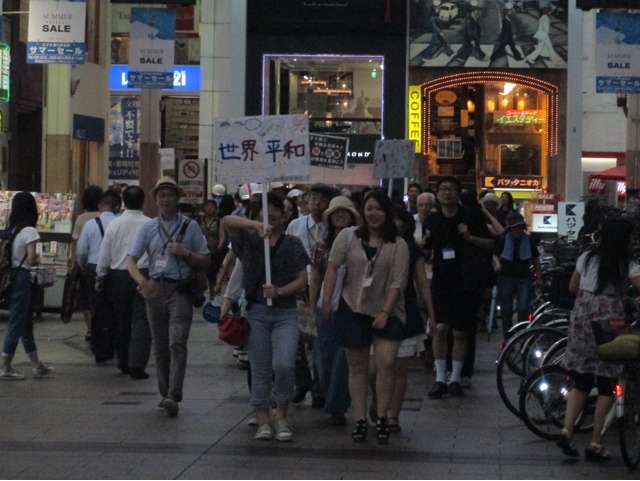
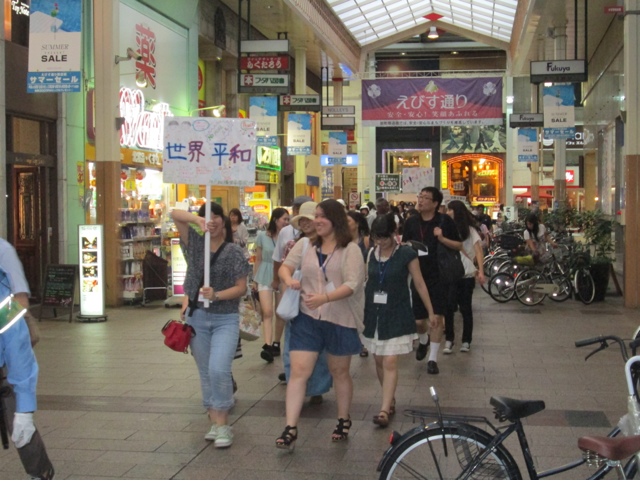
Ran unexpectedly into a Christian peace march:

"Heiwa odori" - "Peace Avenue" (or "Peace Dance Avenue" - I can never get my "o dori" vs "odori" straight)
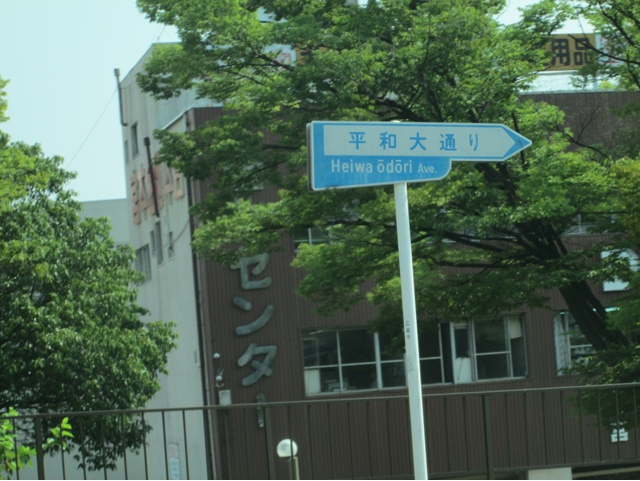
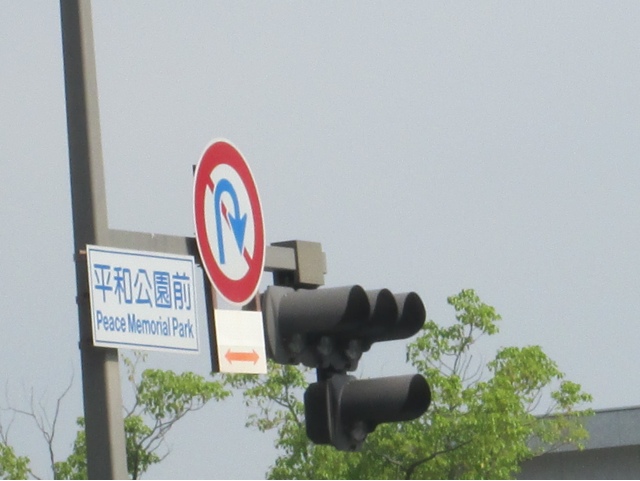
The city's tourism sector trades on the "Peace Brand" ...
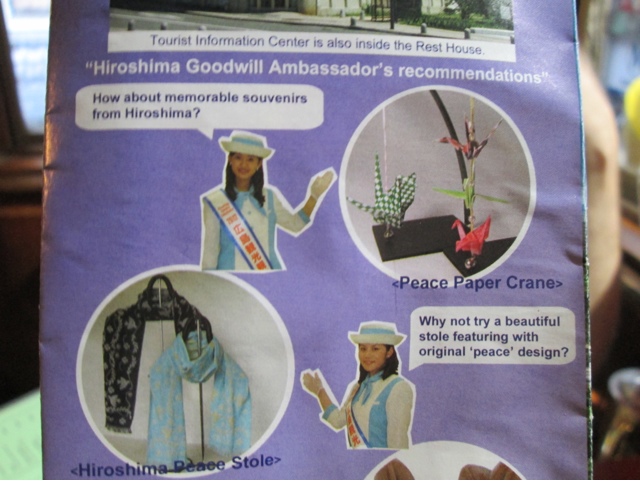
In the park:
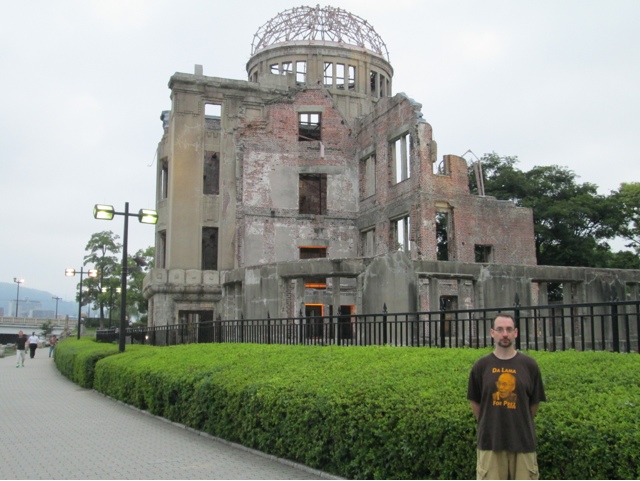
We entered from the rear of the park, and so it was with sudden surprise that I rounded the corner and came face to face with the ruins of the old domed Hiroshima exhibition hall. That's the infamous only-building-left-standing by the bomb, thanks to an ironic trick of physics, because it was directly below the explosion. Ever since, it's been left as a grim, half-destroyed monument. It was like when you first find yourself in front of any structure that you've until now only seen in pictures. It doesn't seem real, or it seems smaller or bigger (in this case, the latter) in person, or you just generally find youself "caught in the headlights," unsure if you're feeling what you're "supposed" to feel in a situation like this.
That feeling. Just heavier. There was emotional humidity in the air, as well as meteorological.
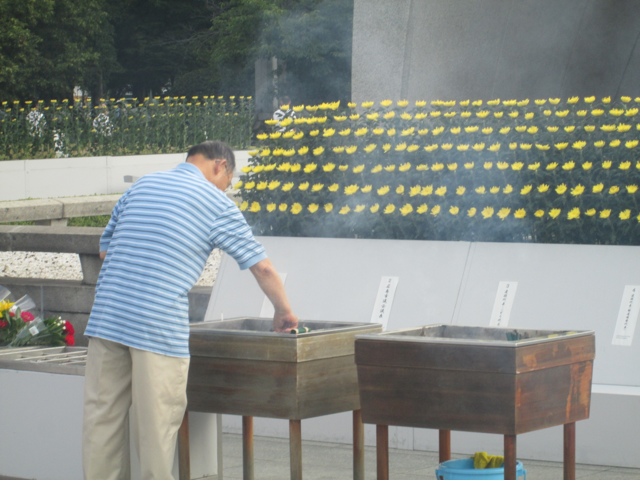
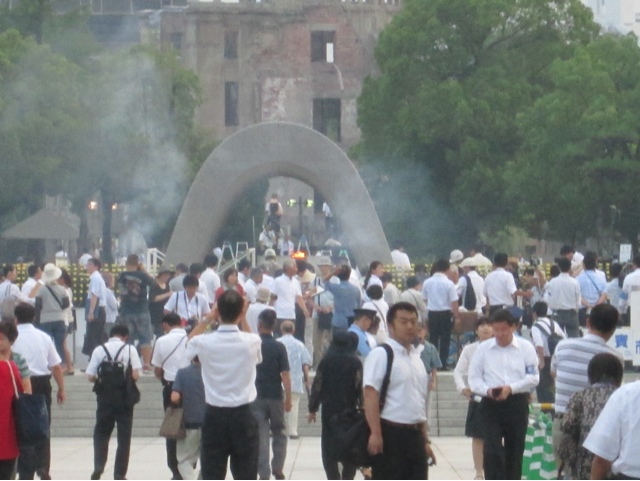
At the center of the park is a cenotaph holding the remains of most of the 70,000 identified victims, to which (I believe) additional ashes are added every time another survivor dies. The cenotaph lies between an eternal flame and an incense burner, both of which were magnifying the increasingly hot and stiltifying weather.
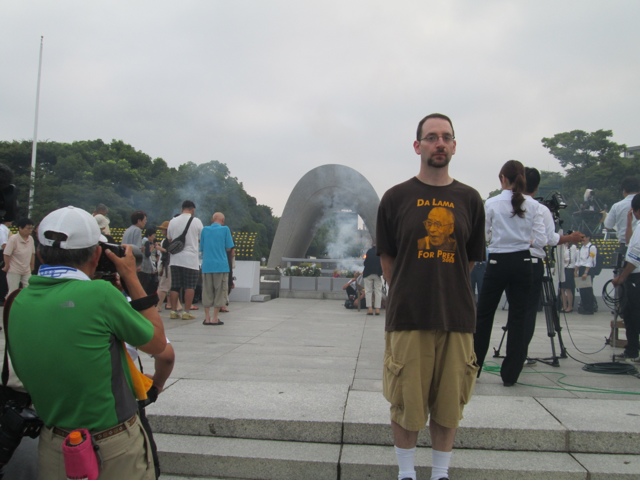
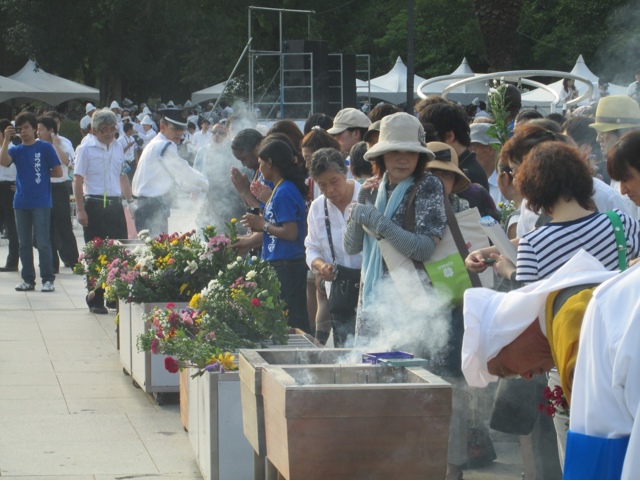
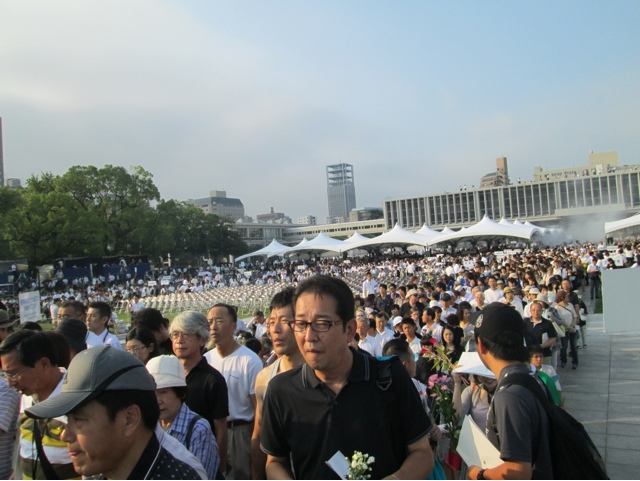
Already, lines of pilgrims were processing, burning sticks and laying flowers. As the hours wore on, this line grew and grew into the thousands. As a veteran of many peace rallies, I know that such events attract all sorts, some more directly plugged into the "official" cause than others. On the peace park grounds alone, I saw my share of antiwar protestors, mourners, Buddhist monks, Christian ecstatics, school groups, tourists, and just the plain curious. Outside the grounds, behind police cordons, I could hear more virulent groups shouting on loudspeakers - I didn't understand the Japanese, but the tone was unmistakeable. Regrettably, I didn't manage to get close enough to see any of them.
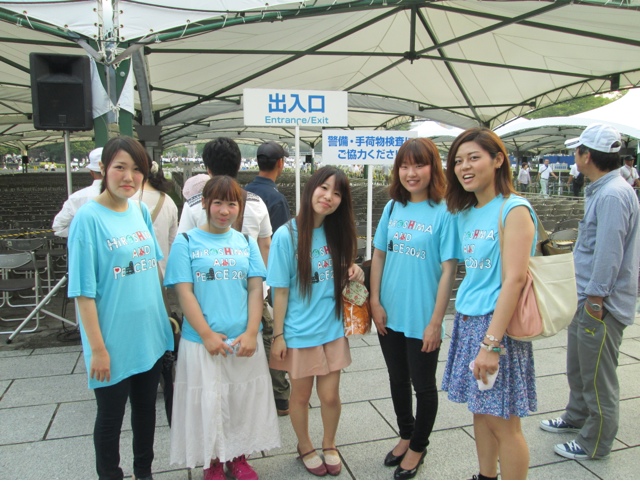
Inside the park, though, the mood was solemn and entirely peaceful. A veritable army of white-shirted volunteers provided everything from water to towels to flowers. Mist-machines, installed at various locations, at first seemed insane devices to use on such a humid day, until the genius of it hit us: as they clouded the air, they diffused the direct, blasting sunlight. Recorded announcements asked people to stay hydrated and to be mindful of others - "don't use a parasol, or if you must, be careful not to poke anyone with it."
I had expected more Westeners. As I spent the morning mingling and circling, I saw just a handful of white faces in the crowds, and every one I got close enough to hear was speaking a language other than English. No one identifiably "American" in sight.
Already, lines of pilgrims were processing, burning sticks and laying flowers. As the hours wore on, this line grew and grew into the thousands. As a veteran of many peace rallies, I know that such events attract all sorts, some more directly plugged into the "official" cause than others. On the peace park grounds alone, I saw my share of antiwar protestors, mourners, Buddhist monks, Christian ecstatics, school groups, tourists, and just the plain curious. Outside the grounds, behind police cordons, I could hear more virulent groups shouting on loudspeakers - I didn't understand the Japanese, but the tone was unmistakeable. Regrettably, I didn't manage to get close enough to see any of them.
Inside the park, though, the mood was solemn and entirely peaceful. A veritable army of white-shirted volunteers provided everything from water to towels to flowers. Mist-machines, installed at various locations, at first seemed insane devices to use on such a humid day, until the genius of it hit us: as they clouded the air, they diffused the direct, blasting sunlight. Recorded announcements asked people to stay hydrated and to be mindful of others - "don't use a parasol, or if you must, be careful not to poke anyone with it."
I had expected more Westeners. As I spent the morning mingling and circling, I saw just a handful of white faces in the crowds, and every one I got close enough to hear was speaking a language other than English. No one identifiably "American" in sight.

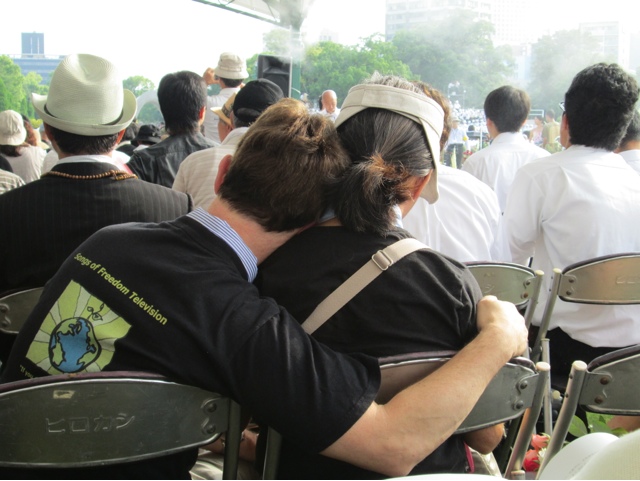
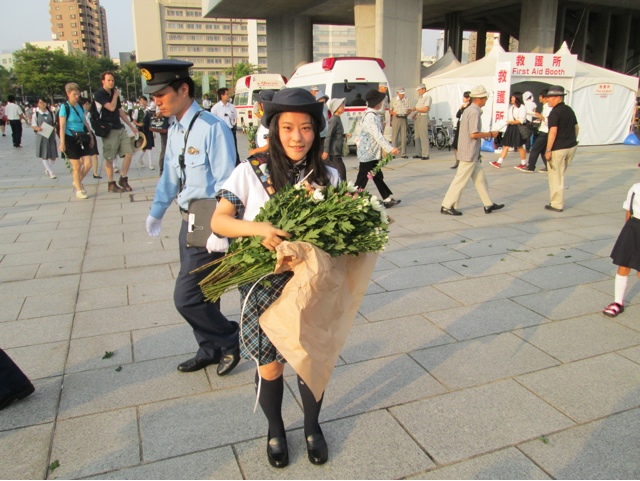
Folks we met:
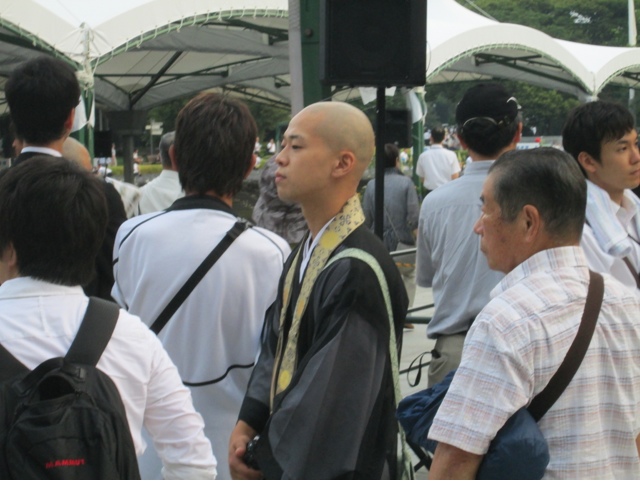

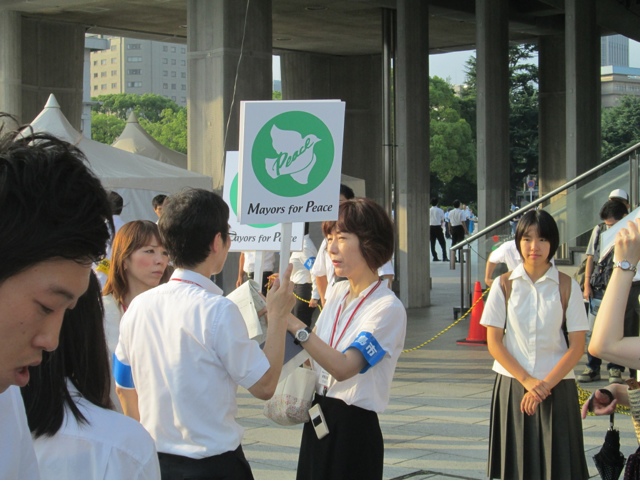

Praying for the dead, and for the living:
Line of pilgrims:


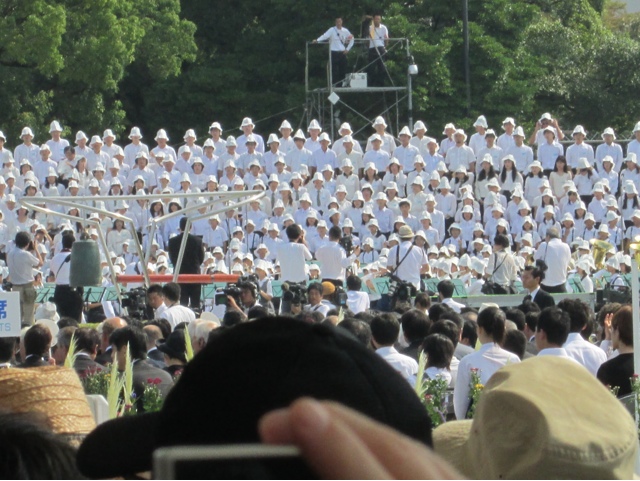
The official ceremonies begin:
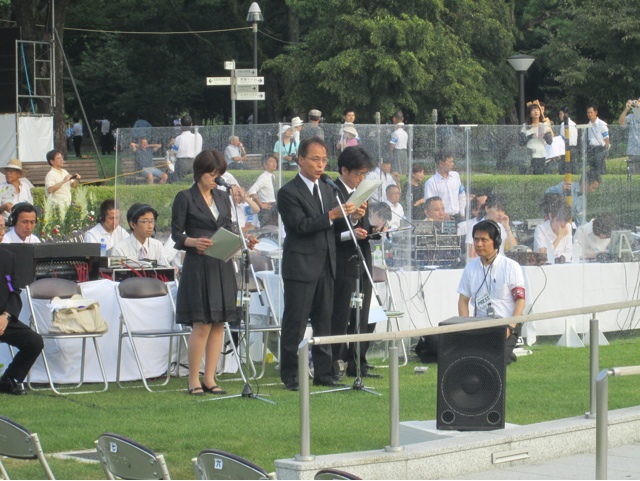
I was surprised at how much access I had, climbing around and taking photos. Although cops and official-looking people were everywhere, no one batted an eyelash at this weird white dude, completely underdressed in his Dalai Lama tee-shirt (most everyone else was in business casual to formal wear, despite the weather), running around taking snapshots and video of everyone and everything, even when obvious muck-a-mucks were there.
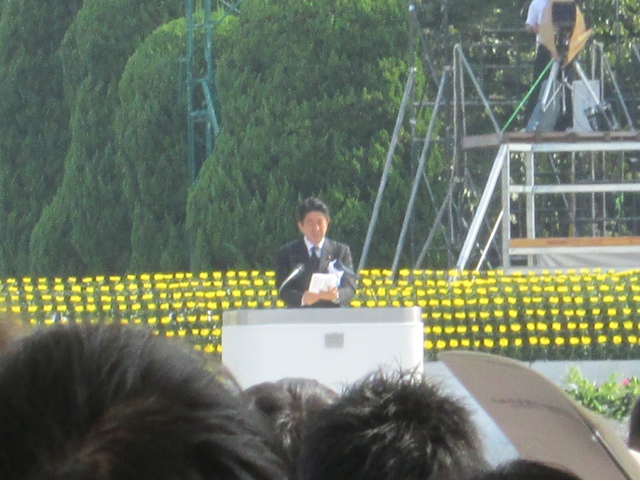
And muck-a-mucks there were aplenty. The city council of Hiroshima laid a wreath at the cenotaph. Japanese Prime Minister Shinzo Abe was present, and spoke. UN Secretary General Ban Ki Moon was listed as a speaker, but sent a flunkie instead.
The ceremony was almost entirely in Japanese, but the program had an English page for explanation. On the one hand, the rituals were all extremely solemn: City officials offered water at the altar, in memory of the victims who threw themselves into the river in a vain attempt to slake their radiation-sickness-induced thirst. Descendants and families of the victims were called up to place offerings. Two children from a Hiroshima Jr High School made a speech, as did all manner of officials, and I caught enough words to get the gist: prayers for peace, all the world over...trying to take Hiroshima's suffering and turn it into a productive call for nuclear disarmament. Putting a face on victims, past, present, and potential, of war.
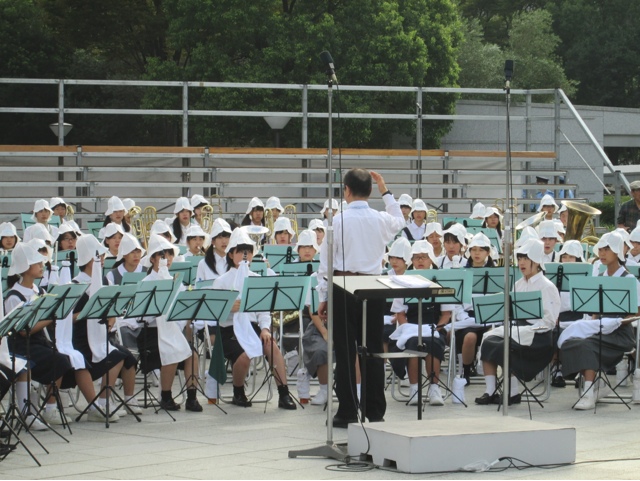
And yet the weird dissonances remained. The brass-band present played music that sounded straight out of a Danny Elfman BATMAN score...melodramatic, Hollywoodish, invoking images of "bif, pow, blam!" It seemed wildly inappropriate to the events it was backgrounding. Or the multiple statements of reverence and respect for the Hibakusha (the bomb victims), hailing them as ambassadors of peace, when I know that for generations they were ostracized, treated as pariahs, blamed for the shame of suviving and shunned for the radioactive and reproductive threats they were seen as. There was no formal acknowledgement (let alone apology!) that I could tell, of this history.
Then there was the fact that the speaker's list included several UN dignitaries, but no Americans. I wondered whose choice this was, and why. Ours? Theirs? Mutual agreement? Just a quirk of this year, and in other years it's different? It made some the rhetoric about peace ring depressingly hollow when the two former enemies who created the conditions that led to this memorial don't share any public and symbolic act of reconiciliation?
Apparently Oliver Stone was in town today. Go figure.


At the end they released hundreds of doves into the air (in Japanese, there is no linguistic distinction I can determine between doves and pigeons...even in English, it's the same bird, just a matter of context), a chorus led the crowd in a Japanese song for peace, and then everyone dispersed in an organized fashion.
Josh and I got snagged by a teacher with two jr. high school students who were clear being assigned to practice their English with a pre-scripted interview about what we thought of the proceedings. I think I wigged them out a bit by asnwering all their questions in Japanese. They gave us little cardboard doves at the end. Very cute.
That was it. Within about two hours the city was entirely back to business as usual, with no sign the ceremony had ever taken place at all.
And muck-a-mucks there were aplenty. The city council of Hiroshima laid a wreath at the cenotaph. Japanese Prime Minister Shinzo Abe was present, and spoke. UN Secretary General Ban Ki Moon was listed as a speaker, but sent a flunkie instead.
The ceremony was almost entirely in Japanese, but the program had an English page for explanation. On the one hand, the rituals were all extremely solemn: City officials offered water at the altar, in memory of the victims who threw themselves into the river in a vain attempt to slake their radiation-sickness-induced thirst. Descendants and families of the victims were called up to place offerings. Two children from a Hiroshima Jr High School made a speech, as did all manner of officials, and I caught enough words to get the gist: prayers for peace, all the world over...trying to take Hiroshima's suffering and turn it into a productive call for nuclear disarmament. Putting a face on victims, past, present, and potential, of war.
And yet the weird dissonances remained. The brass-band present played music that sounded straight out of a Danny Elfman BATMAN score...melodramatic, Hollywoodish, invoking images of "bif, pow, blam!" It seemed wildly inappropriate to the events it was backgrounding. Or the multiple statements of reverence and respect for the Hibakusha (the bomb victims), hailing them as ambassadors of peace, when I know that for generations they were ostracized, treated as pariahs, blamed for the shame of suviving and shunned for the radioactive and reproductive threats they were seen as. There was no formal acknowledgement (let alone apology!) that I could tell, of this history.
Then there was the fact that the speaker's list included several UN dignitaries, but no Americans. I wondered whose choice this was, and why. Ours? Theirs? Mutual agreement? Just a quirk of this year, and in other years it's different? It made some the rhetoric about peace ring depressingly hollow when the two former enemies who created the conditions that led to this memorial don't share any public and symbolic act of reconiciliation?
Apparently Oliver Stone was in town today. Go figure.

Prime Minister Shinzo Abe:


Release of doves:
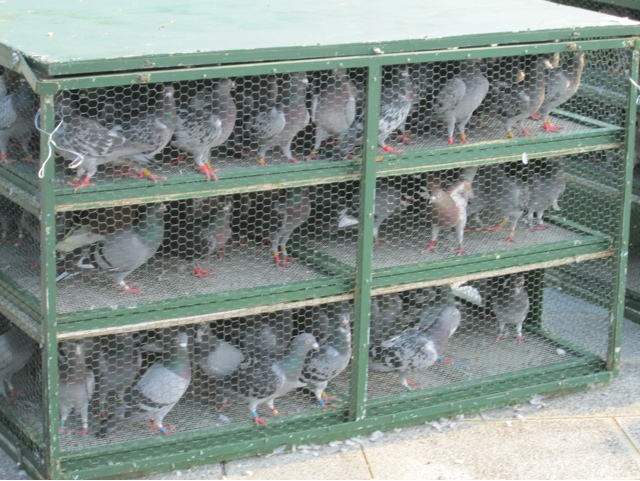
At the end they released hundreds of doves into the air (in Japanese, there is no linguistic distinction I can determine between doves and pigeons...even in English, it's the same bird, just a matter of context), a chorus led the crowd in a Japanese song for peace, and then everyone dispersed in an organized fashion.
Josh and I got snagged by a teacher with two jr. high school students who were clear being assigned to practice their English with a pre-scripted interview about what we thought of the proceedings. I think I wigged them out a bit by asnwering all their questions in Japanese. They gave us little cardboard doves at the end. Very cute.
That was it. Within about two hours the city was entirely back to business as usual, with no sign the ceremony had ever taken place at all.
We took a train out to Miyajima island to de-stress a bit, but that's a story for next entry. I'm still left processing the whole event, my camera loaded with photos and video footage...trying to do "my part" to present this to my students and invite them join in the grappling-with-this process. I tell myself that this makes some small quantum of difference, like some weird generative version of the radioactive fallout that lasts through generations.
I will say that in Miyajima, and later on the platform back to Hiroshima, we met a well-put together looking college student from Oberlin who was traveling through Japan after visiting her father in Kyushu. Blonde, blue-eyed, stepped-right-out-of-a-J-crew-catalog look. We asked her if she was in Hiroshima for the Peace Day ceremonies, and she smiled pleasantly. "Oh, I didn't even know any of that stuff was happening today." She'd obliviously, unapologetically, been spending the day elsewhere in the city as a tourist, and seemed utterly undisturbed by this new information.
For the life of me, I can't at the moment figure out whether to feel disappointed in her, or to think she somehow got it right.
- D
I will say that in Miyajima, and later on the platform back to Hiroshima, we met a well-put together looking college student from Oberlin who was traveling through Japan after visiting her father in Kyushu. Blonde, blue-eyed, stepped-right-out-of-a-J-crew-catalog look. We asked her if she was in Hiroshima for the Peace Day ceremonies, and she smiled pleasantly. "Oh, I didn't even know any of that stuff was happening today." She'd obliviously, unapologetically, been spending the day elsewhere in the city as a tourist, and seemed utterly undisturbed by this new information.
For the life of me, I can't at the moment figure out whether to feel disappointed in her, or to think she somehow got it right.
- D
Subscribe to:
Posts (Atom)